Counseling, Life Coach, Psychotherapy

Be the Mighty Zen Gator

Be a Mighty Zen Gator

Seek the Balance of the Fierce and Zen-Like Gator

In the natural world, gators 🐊 have evolved to thrive with remarkable efficiency. They do not squander their precious time and energy on endeavors that might deplete them, unless those pursuits promise substantial benefits. These creatures, seemingly indifferent to the world around them, lurk below the surface, always vigilant for opportunities and threats—continually evaluating, “Will this help me?” or “Will this harm me?” It’s only the truly worthy morsels that trigger a gator’s response.

As humans, we encounter our own version of “tasty morsel” experiences along our life’s path. Before we react, we too have the opportunity to pause and ask ourselves, “Will this harm me?” or “Will this help me?” It is within this critical space between experience and response that our mental health and well-being are profoundly influenced.

By mastering the art of remaining present and responding mindfully, we can unlock the potential for a more intentional and rewarding life. Just like the gator carefully selects its prey, we can learn to discern which experiences are truly worthy of our attention and action.

When an experience proves worthy of the “chomp,” it’s time to take action and fully savor the moment. Embrace the opportunity with enthusiasm and enjoy the benefits it offers. But what about those experiences that do not merit the “chomp”?

In these instances, we can draw inspiration from the gator’s wisdom. Rather than mindlessly reacting, we can deploy the tools of a chosen response. Take a moment to examine whether there is anything worth pursuing further. Process the situation thoughtfully and remain in a state of mindfulness, akin to the fierce and tranquil nature of the gator 🐊.

By adopting the Gator Mindset, we gain the ability to navigate life’s challenges and opportunities with a sense of purpose and clarity. We become masters of discernment, able to differentiate between what serves our well-being and what doesn’t. Through this practice of mindful response, we can cultivate a more intentional, harmonious, and rewarding life journey—one that aligns with our mental health and well-being goals. 🐊

Coaching, Counseling, Life Coach, Psychotherapy, Therapy

Is This Mine to Carry?

When you find yourself upset by a situation or person, ask yourself if the thoughts, feelings, or actions from the situation or person is yours to carry.

With this, it could be helpful to visualize a bag (or an assortment of bags) during these times.

Observe the bag—it’s shape, it’s color, it’s size, it’s contents, it’s weight—and decide whether you wish to pick it up and hold it…or not.

This comes with the parallel awareness and realization that—like airport baggage/luggage—we can only carry/handle so much before being bogged down and overall the contents of the bags preventing us from getting to our gates and ultimately to our desired destination within the optimal experience (i.e., the destination that is aligned with our life values and goals).

A question to ask as you approach a new bag…is this mine to carry? Is this something I choose to carry?

Coaching, Counseling, Life Coach, Psychotherapy, Therapy

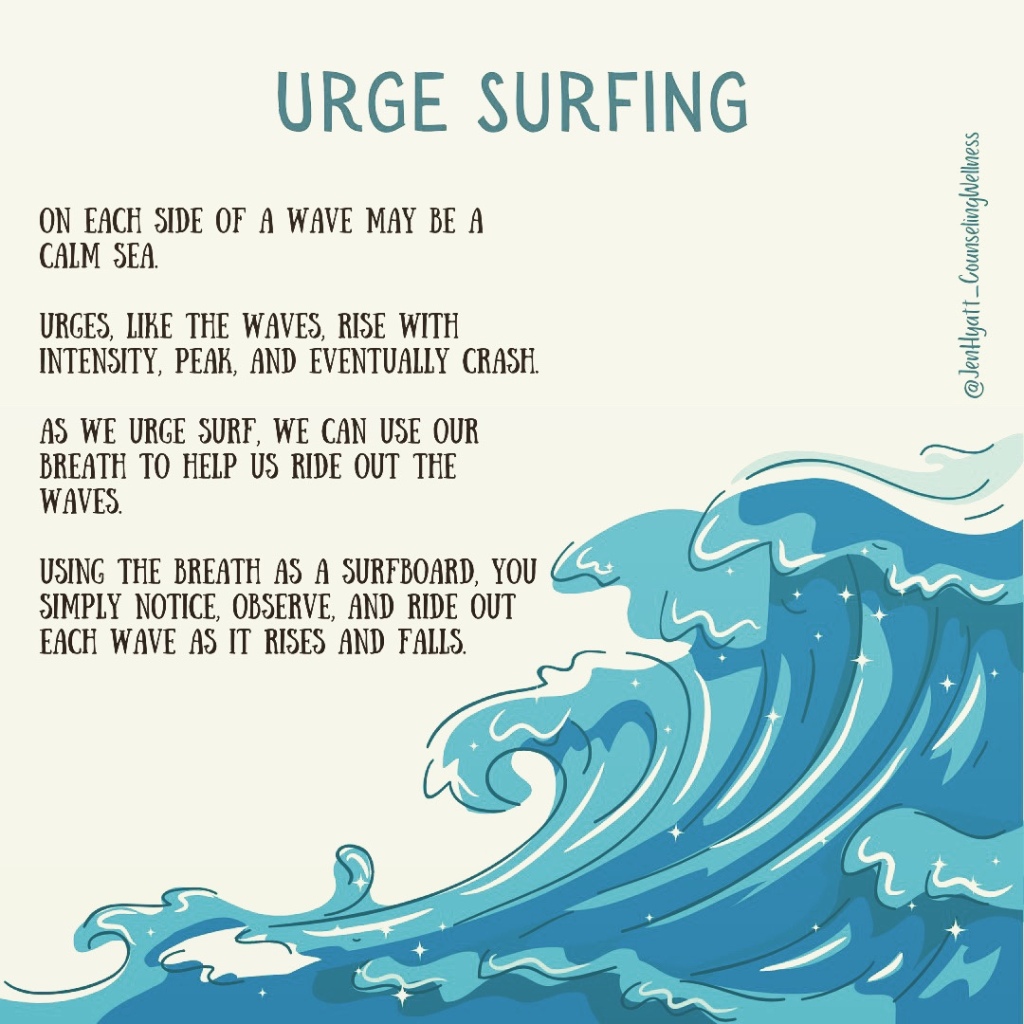
Urge Surfing

Urge surfing can be used with any urges (e.g., urges to avoid, escape, or push away unwanted emotions, urges within procrastination, urges to isolate, urges to self-harm) you experience, including action urges of emotions that don’t serve us well.

Emotions also serve a purpose. Similar to when our stomachs rumble to signal hunger, emotions signal us of a greater need. With this, we can have the urge to run from the action urge of anxiety or grief /loss because of the discomfort of the experience. If we can learn to sit with the emotion, be curious, and identify what it is trying to communicate to us…we can, in turn, take positive action within it and ultimately respond mindfully (versus react) to its signal. When we are able to do this, the strength of the wave is diminished.

To Urge Surf, visualize urges rising and falling like waves. Rather than trying to fight against the wave and be tossed and turned upside down, practice the skill of noticing and observing then surfing the wave until it’s lost it’s power.

Each urge has 3 stages:

RISE WITH INTENSITY

The rise of intensity is when the urge is triggered or begins building up. This is when, if we are able to notice and name what is happening (pay attention non-judgmentally to the sensations that are occurring for us). We can be curious and open to this experience and choose in that moment to not fight against it. We can also deploy our learned coping /mindfulness strategies (breath work, grounding, engage our 6 sensations of sight, smell, touch, taste, hearing plus movement) so that the wave does not grow as big.

THE PEAK

2) The peak is the point the urge is the strongest, like the white caps of the crest of the wave as it peaks. It is slightly before this that we must choose whether to surf and ride the wave or be taken down by it. If we choose to ride, we can continue to take deep mindful breaths as we ride our surfboard. This stage can last up to 20 minutes.

THE CRASH

3) The crash starts when the urge begins to lessen, like a wave after it has peaked and starts falling back into the ocean and towards the reclaimed calm.

Coaching, Counseling, Life Coach, Psychotherapy, Therapy

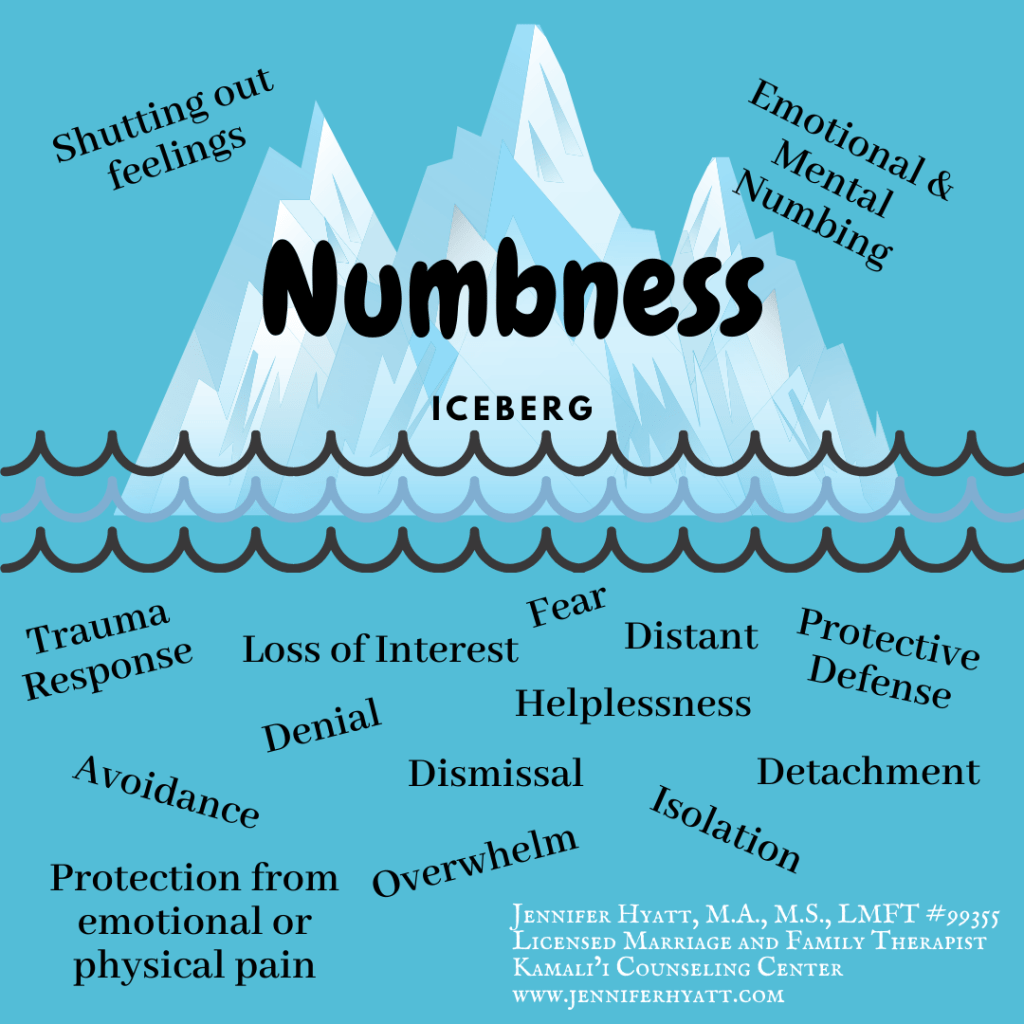
Numbness Iceberg

Part of being human is the experience of emotion. Emotions serve to communicate to us when things are going well and not so well so that we may formulate a response. With this, the feeling of numbness may be something everyone experiences from time to time—from feeling overwhelmed by a life stressor to some form of trauma. Typically the feeling is temporary and allows us mental and emotional processes of shutting out feelings in order to move through something difficult. However, for some, this feeling of emotional numbness can linger for a duration—often serving as a protective defense that guards us from further emotional or physical pain. While this shield of numbness can serve us well in the short-term, such as to get through a life stressor; when it stays for a duration, it can have long-lasting consequences such as the inability to problem solve, experience pleasure and other positive emotions, engage in life, and be the whole person we can choose to be.

Numbness can show up differently for each person. The cause could be wide such as symptoms associated with PTSD, Grief/ Loss, Depression, Anxiety, Abuse/ Neglect, and/ or a whole array of past life experiences that have now come to haunt your present. When feelings of numbness linger or stay for the duration and exceed our ability to cope, it may be time to consult a mental health professional to support in unpacking and processing within the causation of the emotional numbness.

Treatment may include a Therapist (such as myself) who specializes in Cognitive Behavioral Therapy (CBT), Trauma Work, Acceptance and Commitment Therapy (ACT), Dialectical Behavioral Therapy (DBT), Mindfulness, Solution-Focused Brief Therapy (SFBT), and other treatment approaches.